The Secret Language of High-Performing Teams

What if the real issue with communication and collaboration isn’t your people —but the fact that you’re missing the language that helps them succeed?
Your dilemma…
You hire someone new who looks perfect on paper. The skills are there and their experience checks out, yet – within months, communication breaks down, expectations get missed, and team morale dips.
Or: You set your team up to launch a new product. Everyone in the room is smart, driven, and passionate. Somehow, though, they end up contending rather than collaborating.
Both scenarios are common…and they’re also costly. According to the Society for Human Resource Management (SHRM), a poor hiring decision can cost up to five times that employee’s annual salary. And ineffective communication? It’s responsible for an average loss of $62.4 million annually for large companies, according to The Holmes Report. Yes, MILLION.
Here’s the thing – the problem isn’t you and it isn’t your people. It’s that they haven’t (yet) learned the critical secret of high-performing teams: speaking the same language.
The language in question?
It may just be DISC, an assessment utilized by upwards of 75% of Fortune 500 companies to help leaders and their teams understand how behavior leads to business outcomes. The DISC measures observable behavioral tendencies that are driven by individual needs and fears. It suggests how people will typically respond to stress, interact with others, and approach work, conflict, and procedures.
DISC is not a personality assessment (not really), nor is it a measure of intelligence or skills. In fact, it’s a favorite among assesssment models because it acknowledges that people change how they show up over time, rather than suggesting a fixed way of being.
And here’s another reason we find DISC to be so valuable: Most people generally make the mistake of assuming others interact, think, and communicate the same way they do. That’s being human! But when DISC is in the picture, an individual knows their teammates’ profiles - and understands how they differ from their own. That’s where the magic happens.
So, what does DISC actually measure?
The DISC model includes four primary behavioral dimensions: Dominance (D), Influence (I), Steadiness (S), and Conscientiousness (C).
People with a D-style are focused on problems and need challenges to solve. They are often direct in their communication and extremely results-oriented. Dominant styles tend to fear being taken advantage of, or a lack of control around projects and outcomes.
Those who are primarily I-style care most about people and their relationships with others. They may be described as outgoing, persuasive, and enthusiastic. Influencers may fear being left out or losing social approval.
S-style folks seek out solid systems and stable environments – they care about consistency and are patient and dependable. Big and sudden changes can be very intimidating to Steady individuals.
Lastly, those with C-styles are fantastic at analyzing data and following rules. They are precise in their words and actions. Conscientious individuals focus on quality but may struggle with criticism (real or perceived.)
It’s worth noting that all people contain and can (and do) use all four styles – it’s just that most fall primarily into one or two of the buckets. Knowing individual style is beneficial in that it supports people to understand how they communicate, why they may clash with certain people, and how they come across to others.
But where DISC becomes the most valuable is when it’s analyzed and applied intentionally across teams. When looking at groups of people, organizational leaders can use DISC to find patterns that may influence performance and culture. And they can use those patterns to improve both.
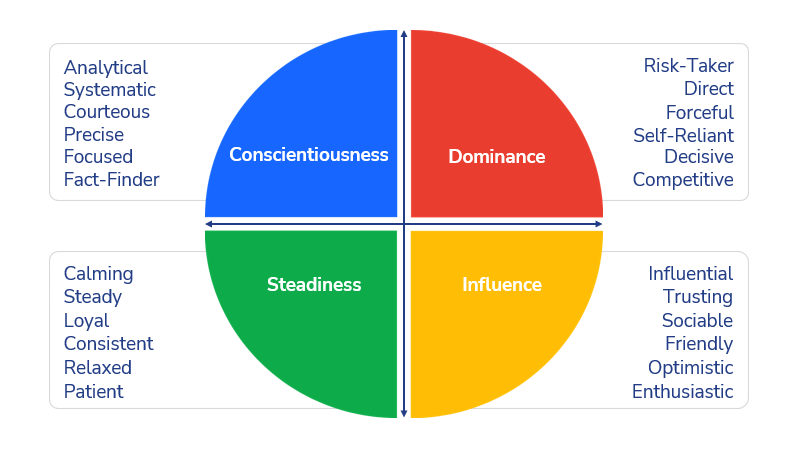
The four DISC domains and how they are often described. Image courtesy of 24×7Assessments.
We took DISC - now what?
The uses of DISC in the workplace are extensive, but where it becomes especially powerful is in how leaders apply the data to build teams that consistently perform at a high level.
One of the most practical applications is understanding team composition. It’s not uncommon for groups to become lopsided in behavioral styles (after all, certain personalities are naturally drawn to certain roles), which can impact overall effectiveness. For example, a team made up primarily of high-C styles may produce exceptional data analysis but struggle to move quickly under pressure. On the other hand, a group dominated by D-styles may drive results at a faster pace but experience more frequent conflict and friction along the way.
DISC data allows leaders to see and understand these behavioral imbalances within their teams. Armed with that information, they can improve collaboration and productivity by upskilling staff in weaker qualities across the group.
Moving from conflict to collaboration
Another use of DISC is to create an atmosphere of productive conflict. Many workplace disagreements have little to do with ability or attitude. More often, they stem from clashing behavioral tendencies. As an example, an I-style communicator may favor brainstorming and leaning into personal connection and conversations, which might frustrate a C-colleague who prefers more structured information and careful analysis. Or, a D-style manager may communicate very directly, embarrassing or hurting an S-member’s feelings.
Without behavioral tendency awareness, these differences can be misunderstood and lead to lingering feelings of friction or unhappiness over time. But with DISC, staff members have a shared language with which to discuss their differences in communication style and are more likely to adjust to suit the needs of those around them.
DISC acknowledges the Golden Rule: “Treat others as you would like to be treated,” and takes it one step further to what they call the Platinum Rule: “Treat others as THEY would like to be treated.” Put another way: DISC encourages awareness and adaptability.
How else can organizations use DISC?
DISC models are an exceptional tool for hiring managers who want to build more balanced and effective teams. They provide insight into how different behavioral styles complement one another, helping leaders avoid overloading teams with similar tendencies (or course correct when this inevitably occurs!) For example, too many D-styles can create a results-driven environment but may also lead to increased conflict or an overly-escalated pace, while incorporating more S-styles can bring stability and collaboration and slow the team down. DISC also supports more strategic role alignment - for instance, C-styles often excel in positions that require precision and analysis, such as financial or data-focused roles, while I-styles tend to thrive in roles that involve influence, relationship-building, and team leadership.
DISC also equips teams with the awareness and skills needed to work more effectively together. It helps individuals recognize their own behavioral tendencies as well as those of the people around them - and, more importantly, learn how to adapt and respond in a way that aligns with each of the four styles. It also outlines observable cues that can help individuals identify others’ tendencies through everyday interactions. This becomes especially valuable when engaging with customers or stakeholders who may not have taken the assessment, allowing for more intentional and effective communication across every interaction.
Ready to get started with DISC?
Luminal Development administeres certified DISC assessments, which come with 40-page, customized reports for each individual who takes them. We also specialize in interactive, engaging and science-based training for teams and HR managers. Built to allow organizations to analyze and utilize the data to improve hiring, performance, communication, and well-being, our workshops are consistently rated “exemplary” by clients.