
Making Work Work for Women

Prioritizing women and non-binary people in the workplace is just good business practice - here’s how you can do that.
It may be Women’s History Month, but inequitable treatment at work is, unfortunately, not in the rear-view for most women.
Organizations’ work of prioritizing women has never been more important, despite the fact that only half of companies are doing so, according to McKinsey & Company and Lean-In’s annual Women in the Workplace Report. This is part of a nation-wide trend in declining commitment to gender diversity, with the same study showing two in ten companies placing low or no priority on women’s career advancement - a number that rises to three in ten for women of color.
Add that to the continuing reality that women earn 84 cents on the dollar earned by men (a reality that won’t be corrected until 2088 if current trends hold), the fact that paid parental leave is not a universal reality for women in the United States (the only country in the high-income, industrialized OCED country not to have these policies), and the fact that women continue to be promoted at significantly lower numbers than men (93 white women, 82 Asian and Latina women, and 60 black women to every 100 men), and it becomes clear that we have a long way to go to reaching equality.
Hope is not lost, however. There are measured, real ways that companies can reinforce their commitment to half the population that get proven results. And when women rise? So does everyone else.
Here, some things that every company should be considering.
1. Institute a sponsor or mentorship program.
Lean-In found that only 31% of entry-level women have a sponsor, compared to 45% of men. Sponsors open doors like recommending their junior colleagues for stretch assignments, connecting them with others who can aid their career development and even putting them forward as candidates for promotion.
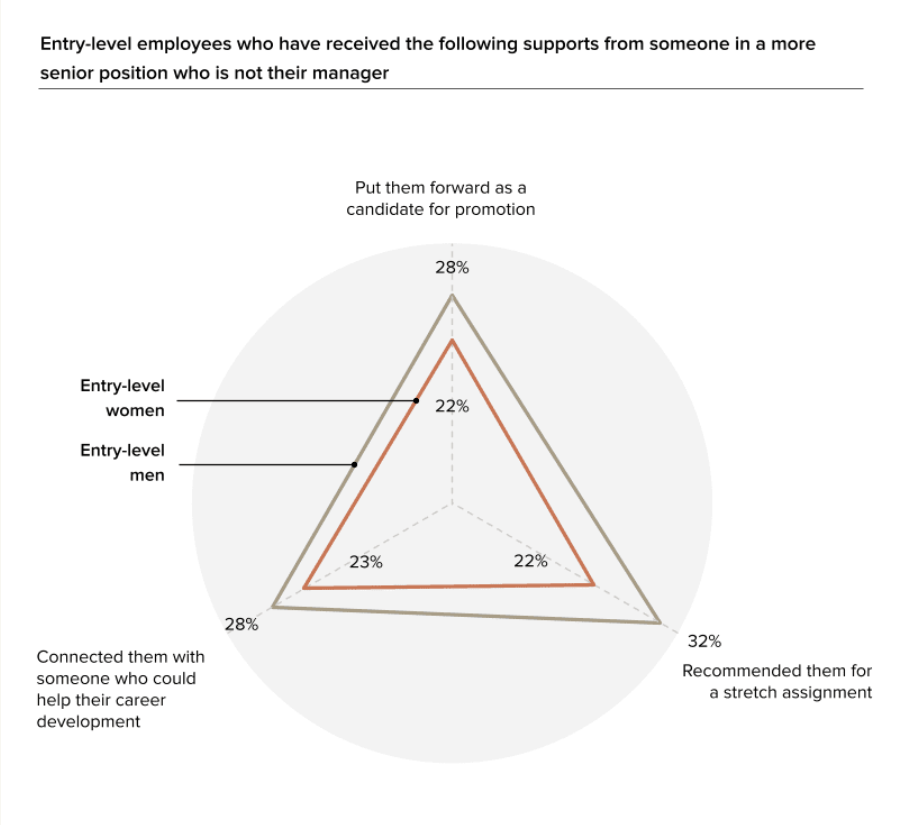
Image and research credit: Lean-In
We know that this type of guidance is invaluable. In fact, 63% of companies with diversity-focused mentoring programs see positive impacts on gender diversity, and employees with formal mentors are 75% more likely to believe their organization supports career development, according to research reported in Forbes. And mentorship doesn’t just benefit the junior level staff member - 70% of companies utilizing mentors found an increase in productivity among staff, and the mentors themselves reported feeling more connected and enaged at work.
2. Offer flexible work. Just do it.
Workplace flexibility that soared during the pandemic is increasingly under threat, with one in four companies discontinuing or reducing their hybrid and remote options last year. That’s problematic, since women are less likely to be promoted or have a sponsor if they work from home, versus men who have relatively similar outcomes regardless of where they work. In addition, women who choose to take advantage of flexible work options are often seen as less productive than their male counterparts.
Offering some level of flexible work is not just helpful to women – it also encourages improved employee well-being, stronger retention and company loyalty and better work-life balance for all employees.
3. Make management more manageable.
Six in ten women in management report feeling burned out, compared to four in ten men. The reality is that managing people is an emotional, often thankless, task, and all managers need the tools and training to do it well (while maintaining their own sanity!)
Investing in management training and leadership coaching for organizational leaders will allow them to feel more in-control and confident in their manager toolkits. In addition, supporting managers by freeing up some of the time they spend on menial tasks creates the space for them to really connect with their teams and more impactfully grow the individuals on them.
Psst – we’ve got you covered here! Let’s talk about it.
4. Put paid parental leave in your HR package.
In the United States, only 13 states and Washington, D.C. have paid parental leave and organizations with 50 or more employees in the other states are only required to offer 12 weeks of unpaid leave. But even when leave is available, most women take less than they could, due in part to valid concerns about how they are perceived after being out of the workplace for an extended time, not to mention financial constraints that often require them to return sooner than they would like to.
The bottom line is that study after study has shown that paid leave improves the health of moms and babies. Simply providing leave and paying people while they take it is a high-impact way to increase retention and equality in the workplace. Even better are companies who encourage their employees to take their full leave, assuring them that the work is handled while they are away.
5. Remove advancement ambiguity.
This year, for the first time in the Women in the Workplace Study, women were slightly less likely than men to say they want to be promoted. This could be because they see burn-out for other women at the top (see tip #3), or because they don’t know what the next rung on the ladder actually looks like.
To address this, companies must be crystal clear about how leveling is handled at the organization. What does each advancing tier of work look like? What are the roles and responsibilities and competencies required in each? How does promotion work, and is it handled in an equitable manner? What type of learning and development is provided? If this information isn’t shared, promotion decisions can easily succumb to bias.
These small steps aren’t hard, but they’re incredibly impactful.
Check out other ideas for building a more equitable workplace from last month and then, if you’re an organization commited to equity, let’s discuss the extra steps you can take to support your staff.